Melodylist 🎵
The History of Musical Instruments🌍 Before Music Had a Name
Long before concert halls, recording studios, or music players existed, human beings were already making music.
Perhaps it began with something very simple. A hand striking a piece of wood. Two stones hitting each other. A voice echoing through a cave. The sound of footsteps becoming a rhythm.
We may never know exactly when the first musical instrument was created. But we can imagine an early human discovering that a hollow piece of wood could make a different sound, or that stretching something tightly could create a tone.
At some point, sound became more than communication. It became rhythm, expression, celebration, memory, and emotion.
And from those first discoveries, the long history of musical instruments began.
🥁 The First Drums and Rhythms
Rhythm is probably one of the oldest forms of musical expression.
Humans naturally hear rhythm everywhere. The beating of the heart, footsteps, rain falling on the ground, waves reaching the shore, and even the repeated sounds of daily work can create patterns.
Early percussion instruments were probably made from materials that were easy to find. Wood, stones, animal skins, shells, and hollow objects could all become sources of sound.
Drums eventually became important in ceremonies, celebrations, communication, and religious traditions across many cultures.
The basic idea remained remarkably simple. Hit something, and it answers with a sound.
🪈 The Effect of the Wind
At some point, humans discovered another fascinating possibility. Instead of striking an object, they could make music by moving air through it.
Flutes and other simple wind instruments became part of ancient musical traditions. Some were made from bones, wood, reeds, or other natural materials.
The principle was beautiful in its simplicity. Air moved through a carefully shaped space and produced a musical tone.
Over centuries, people experimented with length, openings, materials, and shapes. These experiments created increasingly sophisticated families of wind instruments.
The flute, reed instruments, pipes, and many instruments that followed all carry something from this ancient discovery: music can be created simply by giving the wind a voice.
🎻 The World of Strings
String instruments opened another chapter in musical history.
A stretched string can vibrate and create a musical sound. By changing its length, tension, thickness, or material, musicians can produce different notes.
Ancient civilizations developed many types of string instruments. Harps, lyres, lutes, and other early instruments appeared in different parts of the world.
These instruments were not simply tools for entertainment. They became part of storytelling, ceremonies, courts, religious traditions, and everyday life.
The basic idea survived through thousands of years and eventually led to instruments such as the oud, saz, violin, guitar, and many others.
🏛️ Instruments of Ancient Civilizations
As civilizations grew, musical instruments became increasingly connected with culture and society.
Ancient Egypt, Mesopotamia, Greece, Rome, China, India, and many other civilizations developed their own musical traditions and instruments.
Music could be heard in temples, royal courts, celebrations, ceremonies, military settings, and ordinary homes.
Some instruments were designed to accompany voices. Others were created for rhythm, ceremony, dance, or simply the pleasure of listening.
Although these civilizations were separated by enormous distances, they shared something remarkable. People everywhere seemed to feel the need to turn sound into music.
🎸 The Oud, Saz, Lute and Their Descendants
Across the Middle East, Central Asia, Anatolia, North Africa, and Europe, families of plucked string instruments developed and changed over time.
The oud became an important instrument in Middle Eastern musical traditions. Instruments related to the lute family also travelled across cultures and influenced later developments.
In Anatolia, the saz became deeply connected with folk music and the tradition of the aşık, where music and storytelling often travelled together.
These instruments remind us that musical history is not a straight line. Instruments travelled with people. They crossed borders, changed shape, gained new names, and became part of new cultures.
A musical instrument can therefore carry more than sound. It can carry the memory of the people who played it.
🎹 From the Harpsichord to the Piano
The development of keyboard instruments changed the possibilities of music.
Earlier instruments such as the harpsichord allowed musicians to play melodies and harmonies using a keyboard. But the piano introduced something especially important: greater control over volume through the force of the player's touch.
Over time, the piano developed into one of the most influential instruments in Western music.
It could whisper softly, become powerful and dramatic, accompany a singer, or fill an entire concert hall.
Composers began writing music specifically for the piano, and the instrument became central to classical music, education, composition, and eventually many modern musical styles.
🎻 The Rise of the Violin
The violin emerged in Renaissance Italy and gradually became one of the defining instruments of Western classical music.
Its expressive sound allowed musicians to create delicate melodies as well as powerful passages.
Families of related instruments developed around it, including the viola, cello, and double bass.
Together, these instruments formed the string sections of orchestras and became an essential part of chamber music and countless musical traditions.
The violin also travelled beyond the concert hall. Its sound found a place in folk traditions, popular music, film scores, and many other forms of musical expression.
🎷 The Age of New Sounds
The nineteenth century brought major changes to musical instrument design.
Manufacturers experimented with new materials, mechanisms, keys, valves, and shapes. Instruments such as the saxophone were invented during this period, while existing instruments continued to evolve.
Brass instruments became more flexible. Woodwind instruments gained improved key systems. Pianos became larger and more powerful.
Music was entering an age in which technology and craftsmanship could work together.
The orchestra became larger, musical styles expanded, and musicians gained access to sounds that earlier generations could hardly have imagined.
🎸 Electricity Changes Music
Then electricity entered the story.
Amplification made it possible for relatively quiet instruments to be heard by large audiences. The electric guitar transformed popular music, while microphones, amplifiers, speakers, and electronic instruments opened completely new possibilities.
Jazz, rock, pop, electronic music, and many other genres developed alongside these technological changes.
The musician was no longer limited to the natural volume of an acoustic instrument.
Sound could now be amplified, shaped, distorted, recorded, edited, and reproduced.
💻 The Digital Musical Instrument
Today, a musical instrument does not always have strings, keys, reeds, or a physical body.
Computers and digital technology can create sounds entirely through software. A keyboard can control hundreds of different instruments. A small electronic device can produce sounds that would once have required an entire orchestra.
Digital instruments have changed how music is composed, recorded, performed, and shared.
Technology has not replaced the basic human desire to make music. It has simply given that desire new tools.
✏️ The Story Continues to Be Written
When we look at the history of musical instruments, one thing becomes clear. Instruments have changed, but the reason behind them has remained surprisingly familiar.
Someone wanted to express something that ordinary words could not fully explain.
So they created a sound.
That sound became a rhythm. The rhythm became a melody. The melody became a song, a tradition, a memory, and sometimes a story passed from one generation to another.
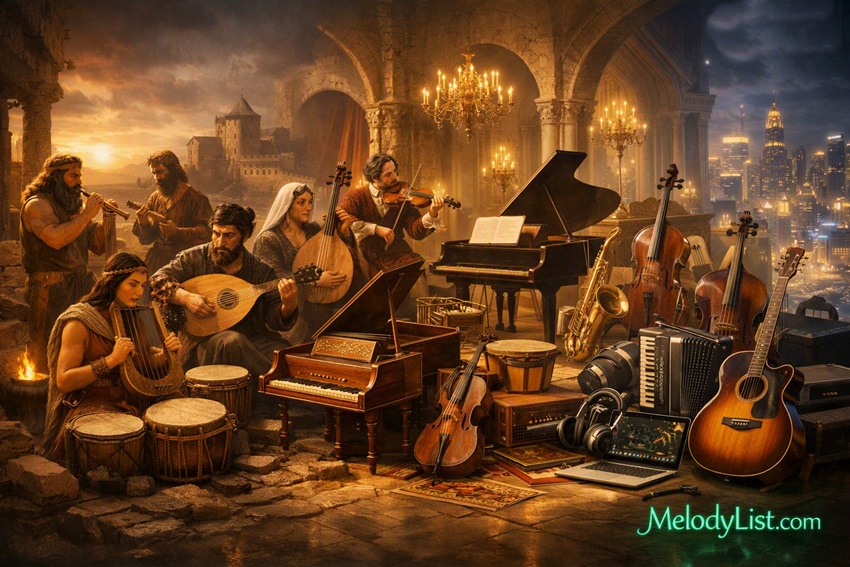
From a simple drum to a digital synthesizer, the journey of musical instruments is really a story about human imagination.
And perhaps the next chapter has not been written yet.