Melodylist Fiction
The Symphony Within UsInside every one of us, a remarkable symphony is playing.
We usually think of music as something we hear through our ears. A piano, a violin, a flute or a drum creates vibrations that eventually become a melody. But there is another kind of music happening much closer to us. It is happening inside our own bodies, every second of every day.
We do not need to press a button to start it. We do not need an audience. We do not even need to listen to it consciously.
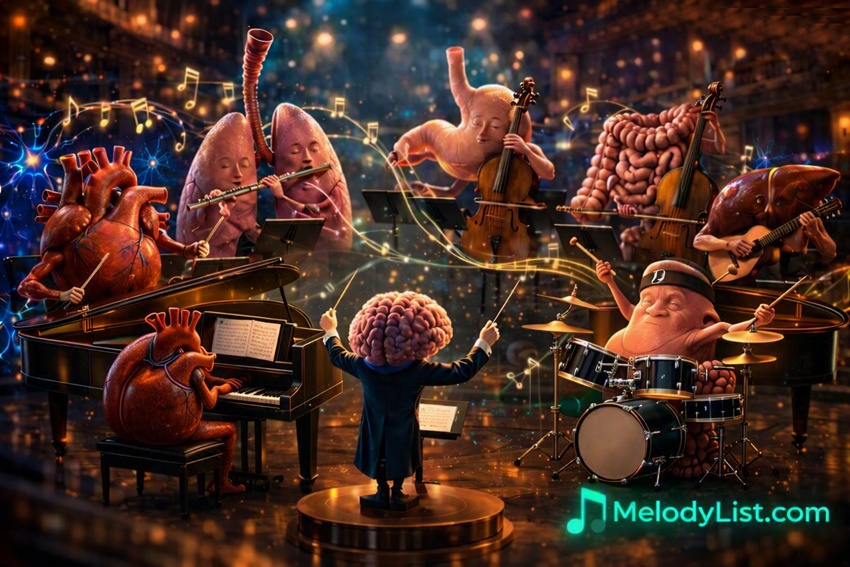
Our heart beats, our lungs breathe, our stomach digests, our blood travels through countless vessels, and our brain continuously receives and processes information. Each organ has its own job, its own rhythm and its own contribution.
Together, they create something that resembles an enormous orchestra.
The heart could be imagined as the percussion section. Its steady beat keeps time for the rest of the body. Like a drummer who quietly maintains the rhythm of a song, the heart continues its work whether we are awake, asleep, walking, laughing or simply sitting quietly.
Then there are the lungs.
Perhaps they are the body's wind instruments. Every breath brings air into the lungs and sends it back out again. Sometimes breathing is deep and calm, almost like a long note from a flute. Sometimes it becomes faster when we run, climb stairs or become excited.
We rarely notice this instrument while it is playing. Yet it accompanies us from our first breath to our last.
The digestive system has its own music too.
The stomach and intestines constantly move and work, processing the food we eat and helping the body obtain the nutrients it needs. Their movements are not a melody we can hear in the traditional sense, but they have rhythm. If we could somehow listen to the entire process, perhaps it would sound like a quiet, continuous bass line beneath the rest of the orchestra.
And then there is the liver.
It does not have the dramatic rhythm of a drum or the easily imagined sound of a flute. It is more like a musician working quietly in the background, performing many essential tasks without asking for attention. It processes substances, stores energy and contributes to many important chemical processes in the body.
The kidneys could be another section of this orchestra, continuously filtering the blood and helping maintain the body's internal balance. Their work is subtle, repetitive and essential.
And somewhere above all of these instruments is the brain.
If the human body were an orchestra, the brain might be imagined as the conductor.
But even that comparison is not quite enough.
The brain does not simply tell every organ what to do. It receives information from the body, processes signals, controls many functions and helps coordinate responses to the world around us. It is constantly involved in an enormous conversation between the body and its environment.
Sometimes the conductor is almost invisible.
We can be reading a book while our heart continues beating, our lungs continue breathing and our digestive system continues working. We do not consciously direct each heartbeat or tell every blood vessel when to change its diameter.
The orchestra simply continues playing.
There are also moments when the music changes.
When we become frightened, our heartbeat may accelerate. Our breathing may change. Muscles prepare for action. The body suddenly sounds like an orchestra moving into a much faster passage.
When we relax, the rhythm can become quieter again.
When we sleep, the concert does not stop. The body continues working, although the character of the performance changes. Some processes slow down, others become particularly important, and the brain enters different patterns of activity.
This is perhaps the most fascinating part of the metaphor.
There is no single musician responsible for the entire performance.
The heart cannot replace the lungs. The lungs cannot replace the kidneys. The brain cannot replace the liver. Each part has its own role, and the body depends on countless systems communicating and cooperating.
Just like an orchestra.
A violin can be beautiful by itself, but an orchestra is something different. Its beauty comes from relationships between instruments, timing, rhythm, pauses and coordination.
The human body works in a similar way.
We often notice an organ only when something feels wrong. Until then, we rarely think about the incredible amount of work happening silently inside us.
Every minute, every hour, every night while we sleep, the orchestra continues.
There is no applause at the end of the performance.
There is no curtain falling.
There is simply another heartbeat, another breath, another signal, another movement, another moment of life.
Maybe this is the most beautiful music we never learned to hear.
The symphony within us.